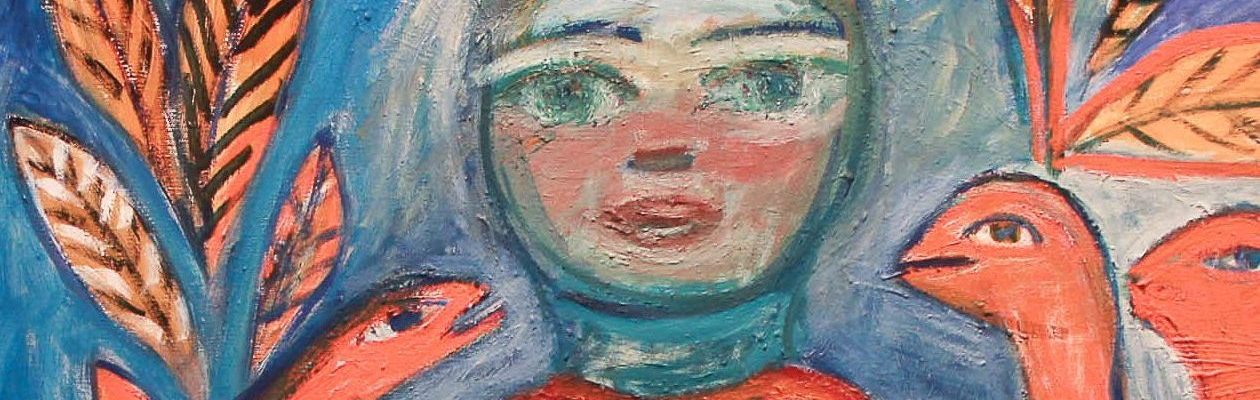
This article is of a wonderful conversation I had with William Mora in September 2016. He has sadly passed away since then, in April 2023. In a subsequent post I’ll share the transcript of the full interview as not all of it was included in this article for the purposes at the time.
For further information on the William Mora Galleries click on the link : https://moragalleries.com.au/

The quest to discover the mystery driving the creative force behind Australia’s greatly admired and highly artistic family, was ironically not unlike an aboriginal painting. It was an exercise in connecting dots of meaning at the core of the Mora family which encompass concepts of creativity, freedom, humour, pain, secrets, spirituality and an intense love for life. With their many ups and downs, the Mora family has instilled through its intergenerational fabric a combination of the French ‘joie de vivre’ and Jewish love for life. This journey to freedom has dots linking the vibrancy of Paris, to Nazi Germany, bohemian Melbourne and an aboriginal culture going back thousands of years.
I spoke with William Mora in his beautiful, architecturally designed home specifically tailored to hold exhibitions in an art gallery section, whilst also providing a studio space for his mother, the renowned French-born Australian artist Mirka Mora. It is here that his 5 year old daughter, who holding her pencil in the same way as Mirka, enjoys painting with her grandmother. William says that “Being an artist is a brave and courageous thing. You’re laying your life on the line. You have to be able to adapt to new ideas”. This is precisely what the Mora family have excelled at. From enduring the horrors of surviving Nazi concentration camps to starting a new life in an unknown country which offered safety, they adapted with courage and became unafraid of the new.
Australia’s embrace of the Mora family is as passionate as their own for Australia which began in 1951 upon their arrival to Melbourne. Having left everything behind in France, grieving for the family they’d lost to the Nazis, the newly wedded Georges and Mirka surrendered wholeheartedly to this new country as home. They cherished their freedom and opportunity to live life to the fullest with French panache, archetypal Jewish humour and great culinary gusto.
The arrival of the newly wedded Mirka and Georges certainly made a splash in Melbourne’s cultural landscape, what to many was considered a backwater by comparison to Europe, and placed them at the centre of an artistic milieu of greats. The Mora’s were fortunate to fall in with an artistic group of people, the head of which were John and Sunday Reed, and with the whole Heide circle, found their perfect fit. The Reed’s were keen on French culture and embraced Mirka’s talent and flamboyant exhibitionistic behaviour. Mirka who had studied at the Jean Louis Barrault School of theatre, loved to be the centre of attention and provoke people, taking them out of their comfort zones which sometimes involved throwing cake.
It has had a tangible rippling effect through their contribution to the arts, restaurant and media scene. A very public family, unconventional in every sense, they have been extensively documented, interviewed, filmed and photographed. Their power to seduce, provoke or entertain is mesmerizing, yet one question remains unanswered. What is it about the Mora family that has led each of them to pursue creative careers so successfully?
There is something unique about this, which led me to explore the question over a philosophical coffee with art dealer William Mora. Ironically, Australia in the 1950s was a very different place to what it is today. Instead of real coffee, people used to drink chicory with water. But today we share a fabulous and perfect espresso.
William describes himself as being like his father, passionate about promoting art. He worked in his father’s business but left because he wanted to start exhibiting Aboriginal art as his father didn’t “get it”. It is from this unlikely dimension that I start to understand the creative driving force at the core of the Mora family.
William explains that before exhibiting any artist he would meet them in their country. Sitting under the stars around a campfire, drinking beer, he shared magical exchanges with talented elders, “The art led me to their culture. I love the different ways an individual artist tells the same story. I get moved by the connection that goes back so many thousand years. The power of the image, continuity, the oral history and wisdom passed down is what the older people carry with them when they make marks on the canvas. It has power”.
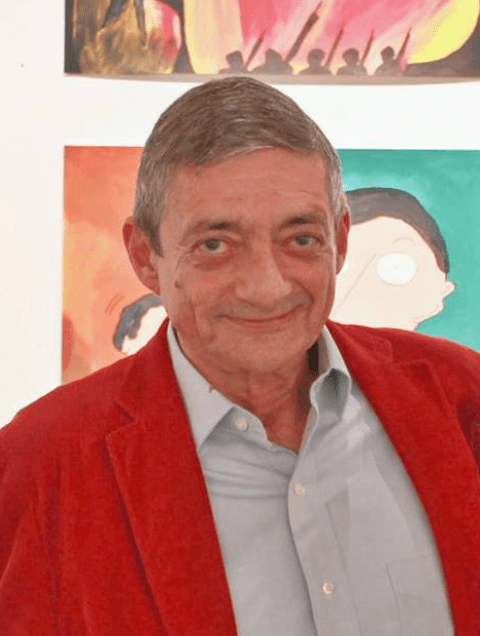
When asked what of the French culture William loves most, he says that the French value artists. To be French is to value your arts, whereas in Australia it’s not seen as a serious activity.
Over time he has felt far more French, spending 3 months of every year in Paris, while his wife and daughter are there for 5 months, “Talking about circles being completed, the park in front of the kinder where our daughter goes in Paris, is the park where Mirka taught my elder brother to walk. She used to go there every day like we do”
Family patriarch Georges Mora reinvented himself as a Frenchman, preferring to offer French food at his restaurants and distancing himself from the past by never speaking German. The most religious instruction he gave his sons was through food at a Jewish restaurant once a week.
Philippe Mora became obsessed with “the German question” making the controversial film ‘Swastika’ about Hitler’s home movies. Philippe’s latest film ‘Monsieur Mayonnaise’ begins with typical Jewish humor “My dad (Georges) actually said that Hitler saved his life. He might have died from overeating as he was a regular patron of Paris’ best restaurants.” Sometimes we laugh so we don’t cry.
Tiriel Mora has led a successful career as an actor following the footsteps of Jean-Louis Barrault school of theatre trained artist Mirka Mora. She once said that she had a desire to reclaim and make sense of family through her paintings, using art to reconstruct a world she can inhabit. William explains that this world is one with the quality of goodness, innocence, all the things she lost as a victim of the Nazis.
I begin to realise that each member of the Mora family, in their own creative way are doing the same thing. They have reclaimed and pieced together their identity in the most uplifting and beautiful way known to human beings, through art. By connecting the dots from the past to the present, they’ve created the ability to heal through the power of continuity.
What makes them unique is their ability to look within, to be vulnerable and rather than escape their pain, to embrace it. They see their ups and downs as a source of creative expression and as a language for connection to others of vastly different cultures. Predominantly it is their defiant love for life that defines them and determination to bring their best forward and that of those around them.
In 1938 an aboriginal man called William Cooper organised a march down Swanston street to protest against the persecution of the Jews and even wrote a letter to Hitler asking him to stop. When I asked William Mora if his connection to aboriginal art has something to do with this shared resilience and empathy for being strong survivors, he told me “Well, they’re like brothers”.
 Passionista Femme International